Tree resin usually feels like an ancient trick. Sticky. Smelly. Designed to keep hungry insects away and scab over the wounds they leave behind.
That’s the standard story.
A new find from China turns that script inside out. The resin emerged in a world that barely resembles our modern forests. No dinosaurs. Not yet. Insects weren’t the major grazers they would later become either. This was a quiet, dangerous place long before the reptiles ruled the earth.
Paleontologists dug up the proof in coal beds in northwest China.
They found hundreds of microscopic fragments. These tiny shards are 385 million years old. That dates them to the Middle Devonian period. It smashes the previous record by 65 million years. It sits 150 million years ahead of the first dinosaur footsteps.
The implications hit harder than the age.
Cihang Luo, first author from the Chinese Academy of Sciences, puts it simply for Science Advances :
“The previous confirmed amber record came from… seed plants. Our amber comes… before seed plants had emerged… This means that a non-seed vascular植物 was already capable of producing chemically simple terpenoid resin.”
Wait. Chemical complexity? Yes.
Amber is the iconic jewel of prehistory. It starts as sticky sap. Time turns it hard. Gold-hued. Gem-quality. But the beauty isn’t the point. It’s the vault inside. It traps pollen. Bugs. Tiny vertebrae. Reptiles sometimes. Paleontologists prize these specimens for snapshots of dead ecosystems. This specific batch offers something else though.
It reveals plant evolution.
Luo says the find proves sophisticated resin biosynthesis appeared way earlier than anyone knew. Think of resin as just another tool in the kit. Right up there with wood. Leaves. Deep roots.
“Resin production may have… been another important innovation… that helped early vascular plants survive…”
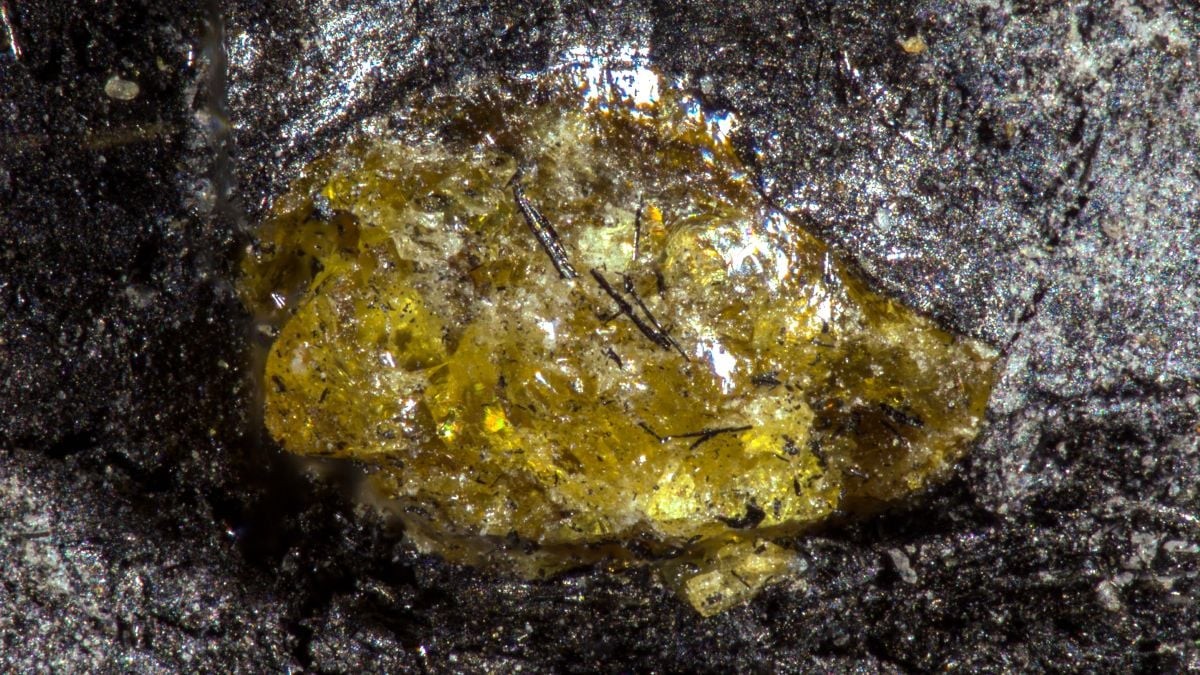
You won’t find golden nuggets here. The samples were tiny. Painstakingly small. Ranging from 0.1 to just 1.5 millimeters across.
The team sifted through 22 pounds of coal. The Hujiersite Formation yielded these 241 specks.
How did they spot them?
UV light.
The resin fluoresced. Glowing against the dark rock. The rock was already dated. 385 million years. The glow? That was the question.
“Our first reaction was excitement,” Luo recalled.
Then caution. Finding 385-million-year-old amber is wild. Too wild? They didn’t want to assume. They treated the stuff as mere resin-like sludge first. Then they hit it with chemical tests.
Optical exams. Infrared spectroscopy. Mass spectrometry.
The data checked out. Conifer-type resin. For real.
They don’t know exactly which tree species produced it. Extinct lineages mostly. But they suspect danger drove the innovation. Wildfires raged then. Parasitic fungi lurked in the damp. Maybe the plants needed a defense system even before the insects arrived to do the damage.
“It was a critical period when plants… [were] transforming the physical structure of continents.”
The environment was wet. Rich in organics. Coal-forming. Patchy stands of vegetation. Simple food webs compared to today’s complex jungles. Just fungi and some land-dwelling arthropods hanging out.
The discovery is in Science Advances. But it’s likely not the final word.
Molecular studies suggest plants had the genes for terpenes way earlier. Much earlier. Maybe as far back as 540 million ago? The Paleozoic Era. The grains found in China are typical in size for that era.
So… what else is out there?
Old amber is hiding. Probably in Early Devonian coal. Or fine-grained sediment. It’s microscopic. Localized. Easily mistaken for other gunk. We’ve been missing it. Or mislabeling it.
Luo thinks UV screening plus geochemistry might reveal older records yet.
Who knows how far back we can actually see.
The resin waits in the stone. Quietly.