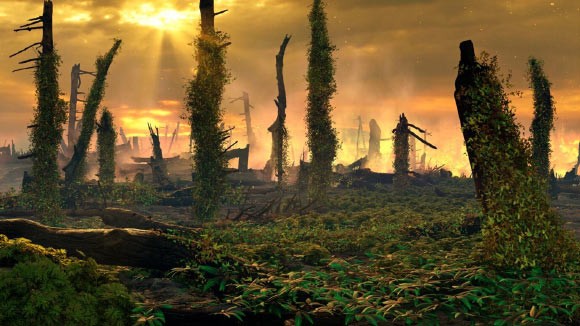
Europe burned. Not once. Not twice. For hundreds of thousands of years, the continent was a tinderbox.
New research published in Nature Geoscience confirms what fossils have long suspected: the End-Triassic mass extinction wasn’t just a slow fade. It was a violent, fire-scarred transformation. A 200-million-year-old climate crisis turned lush landscapes into fern savannahs. And those ferns? They were highly flammable.
The scale of the infernos was staggering. Wildfires raged across Europe, fueled by the very plants that survived the initial kill.
Why Ferns Made the Best Fire Fuel
Ferns are survivors. They’re resilient, adaptable, and frankly, tough as nails. But during the crisis 200 million years ago, their greatest strength became a catastrophic liability.
Dr. Bas van de Schootbrugge from Utrecht University calls ferns “true disaster species.”
“Some ferns can rapidly spread across disturbed lands, and wildfires can stimulate them to spread even further.”
When the world got hot and dry, other plants died. Ferns didn’t just survive—they exploded in population. They formed thick, dry mats of vegetation. Think of it as nature’s own pile of kindling.
When these ferns dried out, they provided the perfect fuel. The thick mats acted as a continuous fire break and a continuous spark. One lightning strike, and boom. The whole region went up.
Ferns are unique because they burn above ground but regrow from underground root systems. They outcompeted everything else in the ash. The fire didn’t stop them. It helped them.
This feedback loop likely kept the “fern spike” alive for 40,000 to 300,000 long, hot years.
A Hellish Feedback Loop
The climate conditions were already hostile. Deforestation had stripped the land. Soil erosion left the earth naked. Strong greenhouse warming baked the soil dry.
Then came the fire.
Weeding and pioneering fern species took over. Some acted as “fire ladders,” carrying flames from the ground up into the canopy of any remaining trees. Others smothered competitors completely.
It was a perfect storm. Climate change. Habitat loss. Opportunistic species. All the ingredients for catastrophe were mixed together.
Ferns responded to the destruction. Then they delivered the fuel that fanned the next round of flames.
“A truly hellish world,” Van de Schootbrugge noted.
How Scientists Proved the Fires Were Global
Finding charcoal in rocks isn’t enough. Charcoal fragments can break down. Smoke molecules—polycyclic aromatic hydrocarbons, or PAHs—can travel thousands of miles before settling. Or they might not preserve at all.
Relying on just one proxy gives you an incomplete picture.
The research team analyzed fossil sediments from drill cores in Germany, Luxembourg, Denmark, and the United Kingdom. They looked at pollen, spores, charcoal, and PAHs. But the real breakthrough came from a surprisingly simple method.
They looked at the color.
The Palynomorph Darkness Index
Here’s where it gets clever.
As organic matter like pollen and spores gets buried deeper, the pressure and heat increase. Normally, this “cooks” the fossils, making them progressively darker. It’s a geological baseline. Deeper equals darker.
But the cores from the extinction interval showed a pattern that didn’t make sense.
The deepest samples—oldest layers—were light. Then, during the extinction event, the pollen and spores turned an extreme, dark brown. After the event, they turned light yellow again.
This wasn’t depth-related. The four basins had different geological histories. They didn’t all bury their sediments at the same rate or depth simultaneously.
Something else turned them black.
Something that hit all of them at the exact same time.
Smoke.
The team took 15,000 color measurements. They compared tree pollen to fern spores. Tree pollen didn’t show the same darkening effect in the same way. The fern spores did.
“All plant groups show the same effect… strong indication that it was the result of of an outside force.”
That outside force was prolonged, intense wildfires.
The “dark zone” of the pollen overlapped perfectly with the fern spike. It matched the peaks of charcoal and PAH abundance.
The evidence was conclusive. This wasn’t local fires. This was continental-scale combustion.
Lessons from a 200-Million-Year-Old Nightmare
We often think of mass extinctions as singular, sharp events. Asteroids. Volcanoes. One bad day.
This study shows that extinction can be a long, burning struggle. A period where the survivors are the ones that feed the destruction.
The combination of warming temperatures, loss of forest cover, and the rise of flammable, opportunistic plants created a self-perpetuating cycle.
The fern savannahs didn’t just exist in the fire. They required it.
What happens when we strip our current landscapes and heat the planet? Do we create our own fern savannahs? Our own tinderboxes?
The answer seems obvious. The past doesn’t repeat itself. It rhymes. And right now, the rhyme scheme looks a lot like smoke.