Einstein had a thing about twins. Specifically, what happens if one leaves Earth. Travel near light speed, wait a few years, come back. The brother left behind? Ancient. The traveler? Barely aged. It is a thought experiment. Beautiful. Impossible.
Forget relativity though. Reality is messier. In real life, the astronaut ages faster. Not just a little bit. Forty times faster than his earthbound sibling. If you stay up there for six months. By certain measures, your carotid artery gets stiffer like it belongs to someone two decades older.
This isn’t just space trivia.
We live on Earth. We suffer from similar insults. Microgravity makes bones atrophy? We sit at desks for nine hours a day. Cosmic radiation? Radon gas is seeping through your basement floor. Disrupted circadian rhythms from 16 sunrises a day? Look at your smartphone at 2 AM.
The parallels are uncomfortably close.
The Kelly Brothers Experiment
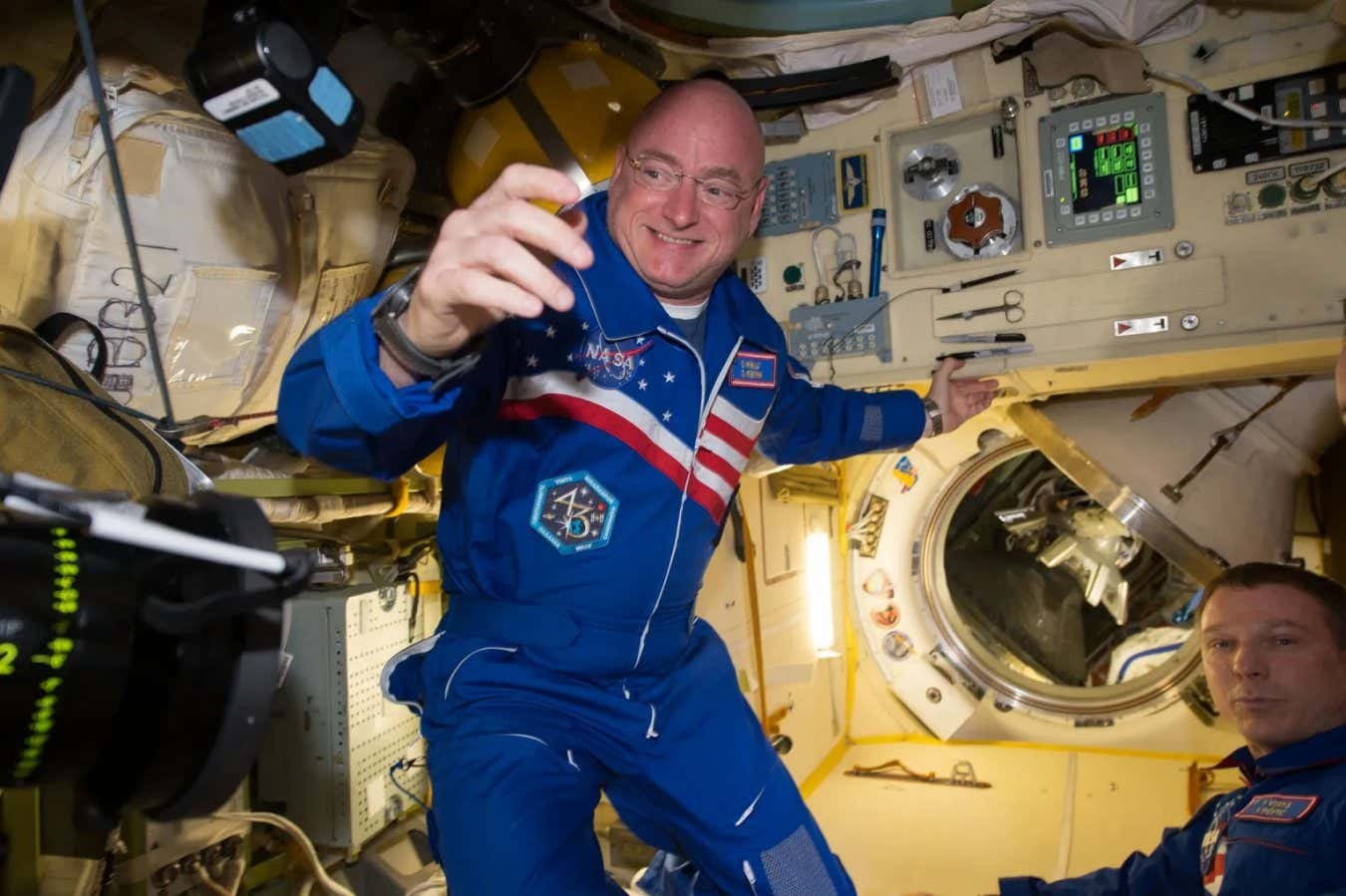
NASA wanted to know. Who better to test on than identical twins? Scott Kelly went up. Mark stayed down. Scott spent a year on the ISS. A full year.
Scientists treated it as the ultimate control group. Sample size of one pair? Roughly useless for broad statistics. But for a snapshot of stressors? Gold.
They tested blood. Urine. Even stool.
The results were stark. Scott returned with high inflammation. Low anti-inflammatory markers. Mitochondrial dysfunction. These are hallmarks of aging. Biological wear and tear usually reserved for the elderly. He hadn’t been to the gym less; his biology was literally breaking down.
Genomic instability followed. Gut microbiome shifted toward rot. Endocrine system confused. Nutrient sensing blunted.
“Spaceflight exposures can be conceptualized as acute, intensified versions of the stressors that drive decline on Earth.”
Why Space Hurts
Daniel Winer at the Buck Institute broke it down. Four killers.
- No gravity. Muscles and bones stop bearing load. They dissolve.
- Light chaos. Sixteen days in a single 24-hour period. Circadian rhythms go haywire.
- Radiation. Galactic cosmic rays hit you hard. 480 chest X-Rays’ worth in half a year.
- Isolation. Just you. And the hum of the life support systems.
These are the pillars of aging. Stress the body with enough of these and senescence accelerates. You get older faster. Not chronologically, but biologically.
The Terrestrial Connection
You might think, so what? I’m not going to Mars. I am stuck in an office cubicle.
Look again.
Winer points out the mirror effect. Sedentary living mimics microgravity. Our bones think there is no need to be strong. So they aren’t. Sleep deprivation from screens mimics the orbital day/night cycle. We isolate ourselves digitally while sitting next to coworkers. We breathe in radon, a heavy noble gas, accumulating ionizing radiation in our lungs without leaving our homes.
The mechanism is opaque. But the model is clear.
Astronauts are the ultimate model organism for aging research. They experience the damage in fast forward.
The Silver Lining?
NASA cares about keeping its astronauts alive for long trips. To Mars and beyond. This urgency drives innovation. They want molecules. Pills. Interventions that halt this rapid decay.
Space programs always leave crumbs behind. Cochlear implants came from space research. Artificial limbs improved. Water filtration systems refined for astronauts now clean water for remote villages.
Maybe anti-aging therapy is next. A fountain of youth disguised as a NASA safety protocol.
We don’t know if we can reverse it yet. We don’t know if the interventions will work on ground-based seniors with decades of slow-acting stressors. The gap between acute trauma and chronic decay remains.
But the path is drawn. We study the stars to fix the flesh. It works sometimes. Maybe it will work this time too. Or maybe we will just age faster while waiting for a pill that hasn’t been invented yet.
That is a possibility.