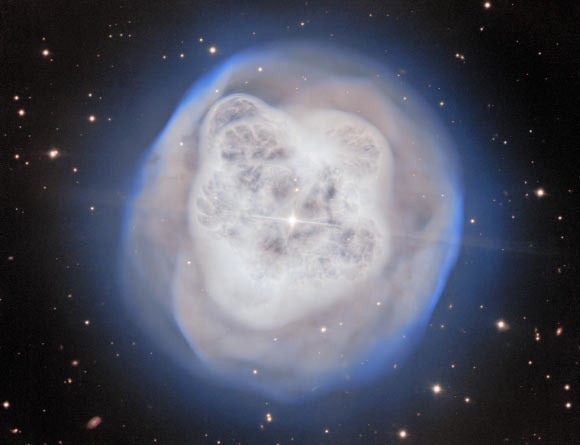
Maunakea sees it best. At 8.1 meters, the Gemini North telescope doesn’t just take pictures; it strips away the haze to reveal something oddly specific, almost intimate, about a blob of gas sitting 1,500 light years out in Taurus.
Misnamed, but Misunderstood?
Call it a planetary nebula. Technically that is what it is. But do not be fooled by the label. William Herschel came up with the term back in the 18th century after spotting round things through his lenses that reminded him of planets he knew from the inner solar system. A bad guess, historically speaking, since planets and these gaseous wreaths have absolutely nothing to do with each other.
He nailed the discovery on November 13 1790. That’s it. A single date for a change in how we looked at the sky. Before NGC 1515—he actually called this one NGC 151—he thought those fuzzy patches were just star clusters so far away their lights blended into static. This nebula broke his model. There was a distinct bright point at the center. A star. Singular, seemingly, and bright. He wrote that the nebulosity wasn’t starry nature. It was illumination from a single source. He was right about the light, wrong about the number.
Inside the Orbital Dance
What we see now thanks to the GMOS instrument isn’t smooth. Planetary nebulae are usually tidy, spherical shells of gas ejected when a star dies out, casting off its outer layers until the core burns hot and energetic enough to ionize the leftovers. This makes a glow. Hot gas glows. This particular glow is running at roughly 15 000 Kelvin. It looks like a crystal ball.
Hence the name. But Crystal Ball Nebula looks like a bruised peach more than any sphere. It’s bumpy. Lumpy shells. Asymmetric.
Why? Because Herschel was only half right. There isn’t one star inside that shell.
Two.
Nine Year Revolutions
They dance together in a tight embrace. An orbit that completes once every nine years. Astronomers at NOIRLab called it the longest period for any known binary pair living inside a planetary nebula. Think about that for a second. Two dying stars circling each other while the gas cloud they created expands around them, dragging history in its wake. The radiation hits the gas, heats it, creates color, but the geometry is ruined by the gravity of two bodies instead of one.
Is it not strange how bad names stick but the reality keeps evolving? We kept the name planetary. We kept the mystery of the bumps. And we finally admitted Herschel missed one of the protagonists in his own discovery story.