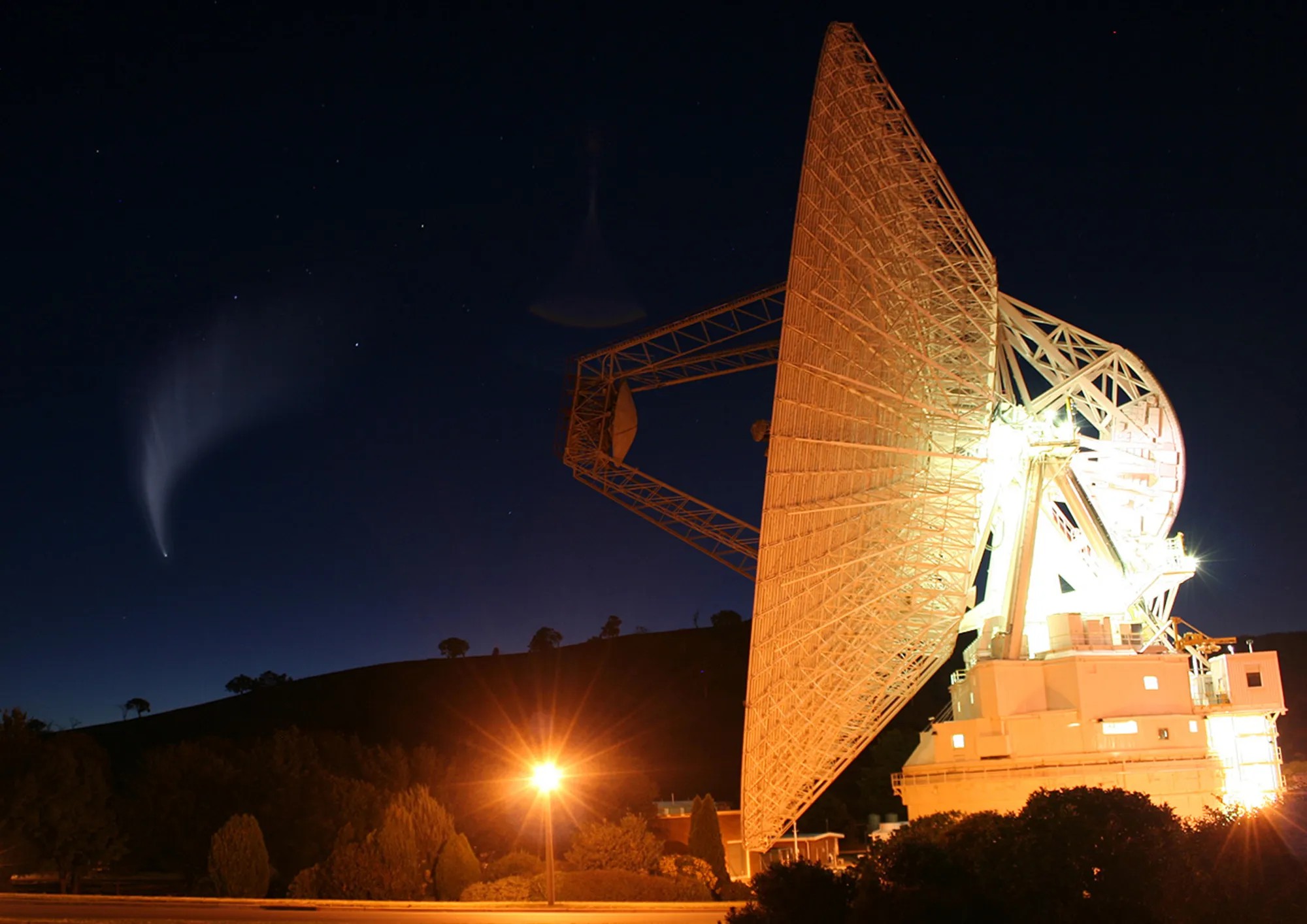
A massive wildfire in Spain is chewing up the land around one of NASA’s three main ears for listening to the universe.
It’s a bad time. The Deep Space Network (DSN) is already stretched thin. Now, the Madrid Deep Space Communications Complex (MDsCC) in Robledo de Chavela is surrounded by smoke and fire.
“The worst fire in the history of the region”
Isabel Díaz Ayuso, president of the Madrid region, called it that. Residents fled. Employees escaped safely. The fate of the giant radio dishes is still a question mark.
How the Spain fire impacts Voyager and Artemis
You can’t just talk to a spacecraft on Mars or past Pluto with your phone. You need massive dishes. The DSN has three locations. Goldstone in California. Madrid in Spain. Canberra in Australia.
They’re spaced roughly 120 degrees apart. This geometry allows two stations to track a single spacecraft at any given moment. It keeps the link stable. It keeps the data flowing.
Now that Spain is out of the loop, the geometry breaks.
Paul Byrne at Washington University in Missouri points out the math. “There will now be times of the day when certain aircraft are out of touch when they otherwise would not have been.”
This hurts missions far out. Think Voyager 1. Voyager 2. Probes that are billions of miles away and sending weak signals. If you lose that third eye in the sky, you lose coverage windows. You can’t just shift the schedule to fix it.
And it’s not just old probes. The Artemis program is ramping up. Moon missions are demanding bandwidth. The DSN was already oversubscribed. Commands wait in line. Data waits to come down.
With one complex damaged, that wait gets longer.
Which backup options exist for NASA deep space network
NASA isn’t sitting idle.
They moved operations to Goldstone in California. For now.
“The agency has seamlessly transitioned support for missionoperations to the Goldstone Deep Space Communications complex in California,” the statement said.
Wait. Seamless?
It’s a bandage. A temporary one.
California can’t do the job of three stations forever. The sky rotates. The Earth spins. There are gaps in coverage that Goldstone alone cannot fill. If the Madrid dishes burn out, the gaps widen. Data might drop. Commands might time out.
We don’t know the extent of the damage yet. It’s too dangerous to go in and look.
So we wait.
The fires are driven by drought and heat. They don’t care about science. They don’t care about the Voyager probes or the next trip to the moon. They just burn.
If the Madrid facility is destroyed, how do we fix the geometry? You can’t build another giant dish complex overnight.
Maybe we won’t.
The signal from the edge of the solar system is faint. It takes years to cross that distance. If we miss it, it’s gone.
We’ll see if the ashes reveal anything left of the dishes.
Or we’ll just listen to the static.